Lanka's Story·Part 1 of 8
Nowosielica
Chapter 1
Nowosielica
My grandmother was born Lanka Moskovitz on March 20, 1920, in Nowosielica, a village of about five hundred people in the hills near Ungvár, in the easternmost province of Czechoslovakia.¹ Four Jewish families lived there among the Ruthenian farmers and field hands. Her Hebrew name was Leah, and at home everyone called her Leitchu, a nickname form of it.
Her father, Meyer Moskovitz, was a shoemaker and a farmer, and the two trades supported each other. He mended boots for the peasants who worked the family’s land, and the same peasants worked for him. Her mother, Bluma, had been born in the village, a Simskovitch, and the farm had belonged to her father before it belonged to them. Her grandfather lived with them, a devout man with a long beard who spent his days and much of his nights at his books, and as he grew older and the farm became more than the family could manage, he began to sell off parts of the land. Lanka was the oldest of four. Herschel came three years after her, then Margaret, and then, many years later, the baby, Samuel. They lived in a house of two rooms and a kitchen, which was small for the size of the family but sat among good land, and by the standards of the village they did well.
Her father’s family came from Konus, a town in Slovakia four hours’ walk away through the woods, and he was one of thirteen children. As a girl she made that walk to see her father’s mother, who baked constantly and always saved something for Lanka, which she handed over quietly so the other grandchildren would not see. Between the two sides of the family she had about forty first cousins, and the Moskovitz relatives in particular stayed close. Some of the family had gone ahead to America, three of her father’s brothers and sisters and two of her mother’s.
Her childhood was short. From the age of seven her mother pulled her out of bed in the dark, sent her to feed the chickens, and went off to milk the cows. Lanka would creep back under the blanket for five minutes and fall asleep, and her mother, coming in and finding her there, would hit her for it. Bluma was a strict woman, and Lanka was afraid of her. The family kept six milking cows, horses, geese, and chickens. The udders were more than her small hands could manage, and when a cow kicked her and the milk spilled, her mother hit her for that too, though it was obviously not her fault. The farm also made brinza, a soft sheep’s-milk cheese, which they dried under the house and carried to the city to sell.² The peasants who had no land of their own depended on the family for work, and in a village where the Jewish families gave other people a living, nobody stole from them and nobody bothered them. The Gentile neighbors, as she remembered it, looked up to them.
The house was strictly kosher. On Friday nights there was always chicken soup, and since the children would not eat chickens they had fed themselves, her mother either bought one or took one of their own and said nothing. There was farfel with carrots, and a dish her mother called galarit, big sweet beans cooked sweet-and-sour with bay leaves. On Shabbat there were two kugels, one of potato and one of cornmeal, and sometimes a third made with cherries. The attic was full of dried fruit, nuts, and apples, and her mother put apples into the sauerkraut. All winter the children climbed up and reached into the barrel to fish one out.
Because the village was too small for a synagogue and had no rabbi, the Jewish families walked to the next village for services, or gathered in the house of the Kalstein family, who also ran the village tavern, and prayed there.³ On Sunday afternoons the peasants gathered at the tavern to drink and dance, and the evenings sometimes ended in fights, so that the Jewish children were kept away from it. Lanka, who was curious and who loved music, once said that she would like to go and play there, and was told that Jewish girls did not go into places like that. On Shabbat the Gentile neighbors did the work the family could not. The boys had Hebrew teachers who were brought to the village. Because the Jewish households were too few to support a teacher each, they shared one, and in the summer he lived in Lanka’s house. The girls learned the Aleph-Bet and then taught themselves to read, and what they understood as a girl’s religious education was simply that they were Jewish and had to keep a Jewish life.
She started at the village school, which taught in Russian and Czech.⁴ The school met on Saturdays, and Lanka stayed home, because the family would not let her write on Shabbat. She studied her lessons on Shabbat instead, so she would be ready when the teacher quizzed the class on Monday. On Thursdays the priest came to teach catechism, and the Jewish children were sent out of the room. Her teacher was a German-speaking man from Switzerland whom the village called the Schwab. He was friendly to the family and often came to the house. When Lanka was seven her father told him that if she misbehaved he should hit her, and a short time later she stepped on the silk flowers planted in front of the school and the teacher struck her hard on the head. She ran home crying. Her father said she must have done something to deserve it, and her mother, who disagreed, walked back to the school with her and demanded an explanation. The teacher said that her husband had told him to.
One boy at school was crueler than the teacher. He sat behind her, hit her whenever he liked, and called her a name that she remembered as toravazsid, which was meant as an insult to a Jew. His family was the only openly hostile one in the village. Everyone else was friendly. The Greek Catholic priest was married, as priests of his church could be, and his twin children were born on the same day as Lanka.⁵ The families visited each other on birthdays. The priest’s wife baked something special so that Lanka could eat in her house, but Bluma forbade it, and Lanka learned to turn the food down. She became friends with the priest’s daughter Manya. The local police, when they came through the village, ate at the Jewish houses because there was nowhere else to go.
The person she loved most was her grandfather, her mother’s father, whom she called Zeidee. He had once owned hundreds of sheep, which three men took out to pasture and stayed with overnight while the women came out to milk. He sang to her when she was small, Jewish songs and Russian ones, including some about Cossacks riding in under red flags with bayonets for any Jew they met.⁶ He was also her protector. One Friday her father, who wanted the corn finished before Shabbat, struck her for leaving off the peeling to go out and play, and her grandfather took him by the neck and told him never to put his hand on her. He asked why a child should be made to sit and peel corn all day, and he helped with it himself, though a whole village’s worth of corn could not be done in a day. The neighbors solved the problem by holding peeling parties on Saturday nights or Sundays, when all the young people came and the work was done by hand, as it had always been, and ended as a party. He died in about 1932, when she was twelve and he was eighty-five. Before he died he called her to his bedside because there was something he wanted her to know, and what he told her was that she should not stay in Europe, because every twenty-five or thirty years the Jews were killed there. He gave her the name of his daughter Frumet, who lived in Pennsylvania and was known in America as Fanny, a devout woman with two sons and a daughter, and told Lanka to write and ask to be brought over so that she could live in her house. She was a child and could do nothing with the instruction.⁷ But it stayed with her, and she came to believe he was still watching over her.
She left school at fourteen. Girls were not sent on to higher school, which would have meant going to another city and eating in strangers’ kitchens, and her parents would not allow it. The Swiss teacher, who had always admired Margaret’s gifts as a student, begged them to let her live with his own parents and keep studying, and they refused for the same reason. Lanka worked at home for a while after she finished, until she decided that she wanted to learn to sew. Soon afterward she began traveling to Ungvár to stay with an aunt, partly to escape the endless work of the farm, and the aunt taught her to bake, poppy-seed rolls and nut cakes, which she copied out and took home. The family had its own outdoor oven, and she learned to judge the heat by putting her hand inside. Her father would announce that Lanka was coming home and that meant there would be something good to eat. She loved to read, above all love stories, and she had to hide her books from her mother. Once, when she heard her mother calling her in from the garden, she pushed the book beneath a tree, and when her mother found it there later, Lanka swore at night that it was not hers and that someone must have left it. She was also, for many years, the only girl of her age in the village, and the boys around her were all younger. A good-looking blonde girl with a gift for baking and a mother who watched her closely, she was restless in a village of five hundred, and she began spending more time in Gross Berezny, a larger town with a big and lively Jewish community that she thought of as beautiful, and where she could learn to sew.
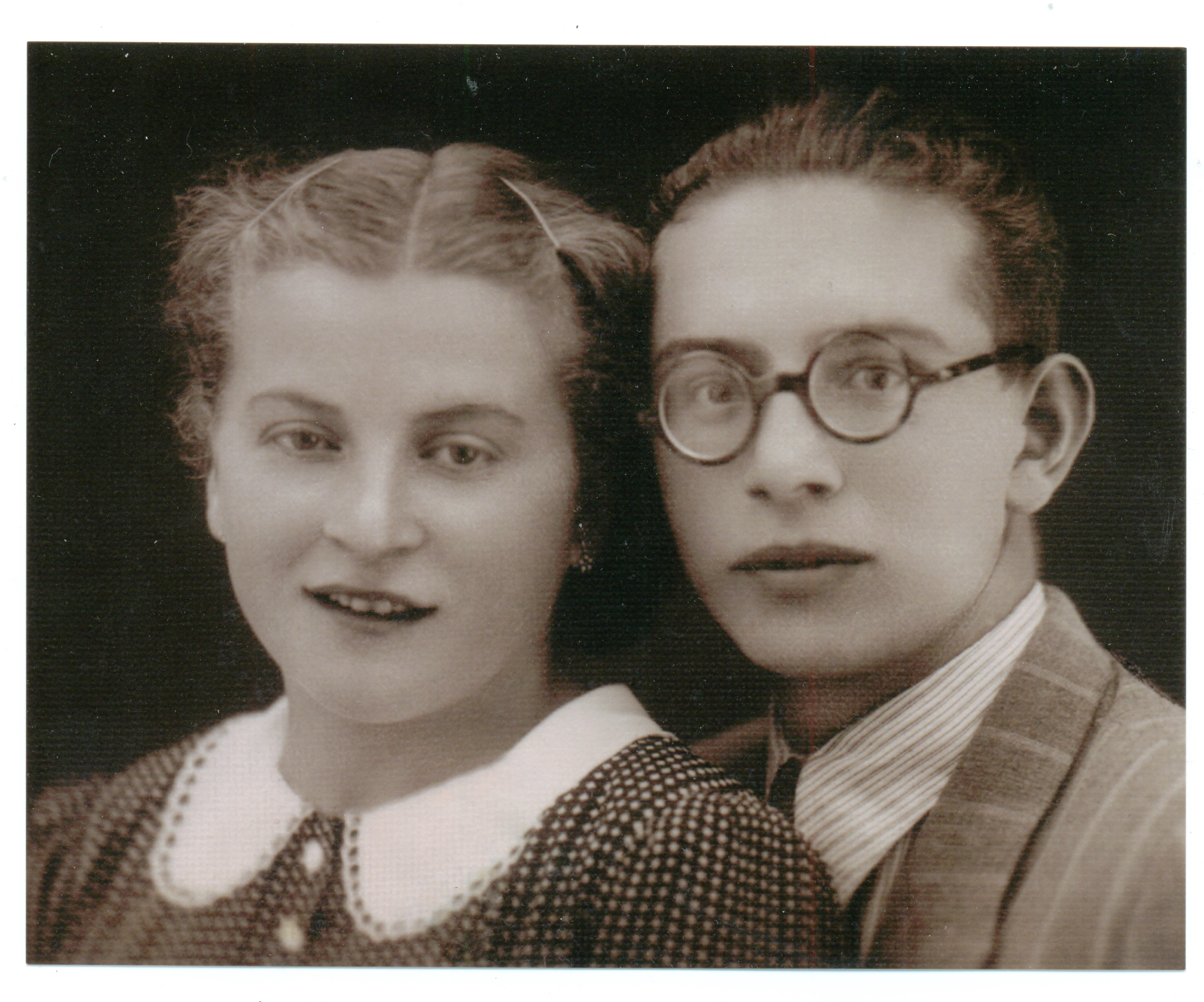
It was in Berezny, on Rosh Hashanah when she was sixteen, that she met the two young men she would later weigh against each other. She had gone with the others to Tashlich at the river, and walking back across a bridge she found herself between them. A woman called out to scold her for going about with two boys on the holy day and asked whom she thought she would marry, and Lanka answered her sharply. At eighteen she married Morris Lebovic. He was a Slovak by birth, which would later matter a great deal. They rented a little house at the edge of town. She had also been seeing another young man from Humenné, who had inherited his uncle’s hardware store. This was Martin Ilkow, my grandfather. Her mother knew both of them and told Lanka to marry Morris, who was religious and, she said, would give her the moon if he could.⁸
Lanka and Morris Lebovic - Lankas First Husband - This is the earliest picture of Lanka I have
In March 1939 Czechoslovakia broke apart and Hungarian soldiers marched into Subcarpathian Rus’.⁹ They reached her village on a Friday, the afternoon when the Jewish women had just baked their challahs, and they went from house to house and took them. There was no time to bake more before Shabbat. It was a small thing and also a sign of what was coming, and she never forgave the Hungarians for it. In the years that followed she came to think of them as worse than the Germans, who in any case never came near the village.
The new rules came gradually. Jews were no longer allowed to slaughter animals themselves, so her family bought meat from a Gentile butcher and told anyone who asked that they had killed it themselves.¹⁰ On Fridays the gendarmes would stop by and ask where the Shabbat meat had come from. The butcher, who was Hungarian but not an anti-Semite, told her that if they asked him, he would say she had bought it, and she did not have to worry. The police were not all bad, but the family could no longer rely on any of them. The boy from school and his family, now with the Hungarians in charge, tore a plum tree out of the hillside orchard behind the house, roots and all, and threw stones down at the house from above. Her father went after them with a stick. They called the police, who did nothing, and the matter was dropped.
Martin did not wait to see what would happen. He talked a great deal, and the Hungarian gendarmes, who kept dropping by his store and taking what they wanted, decided he was a communist. He was not one. They told him they knew what he was but that as long as he had lived there he had nothing to worry about, and that reassurance worried him more than a threat would have. He made up his mind to leave for the Soviet Union and told Lanka and Morris his plan. He wanted them to come with him. She was frightened and could see no reason to go to Russia, and Morris said that he had done nothing and had nothing to run from. So they stayed, and Martin went alone.¹¹
The stories from outside kept coming closer. After the invasion of Poland in September, refugees came through the Carpathians into Hungary, among them a Polish photographer whose arm had been broken, who told people that the Germans were killing Jews. People listened politely and did not believe him.
In the summer of 1941 the danger reached the household itself. Hungary had joined Germany’s invasion of the Soviet Union that June, and as the army moved east the police began rounding up Jews who could not prove they were Hungarian citizens, among them men born in Slovakia and the other lands of the former Czechoslovakia, whom the authorities treated as foreigners to be expelled. Morris had been born in Slovakia. His brother’s family was taken first and driven toward the border, and from that day Lanka lived in fear. When the police came through the town, she and Morris sometimes slept out in the woods rather than be found at home.
Then Morris himself was taken, as she was told, for forced labor.¹² Orders came by telegram, and men could sometimes buy their way out. She paid five hundred pengő to get him released, and he came home for three or four weeks before a second telegram called him back. After that she followed him from place to place for as long as she could, as far as Romania. At one stop there was no hotel, and the only place she could find to sleep was in the house of a Greek Catholic priest. At the end he was taken to Budapest, and he told her he had a feeling that he would never see her again. When she wanted to go and visit him there he told her not to come. From Budapest he was sent to Poland, and she never saw him again.
It was some time before anyone understood where the deportees had been sent. Then a young woman, one of the beautiful daughters of Morris’s brother, whose family had been deported across the border as foreigners, came back to the village with a Hungarian officer who had fallen in love with her and taken her to his parents. She told them that the Jews had been forced out of trucks and into a river and shot if they tried to swim.¹³ Nobody knew what to do with that, so the village went on with its life, but Lanka feared from then on what it meant for the Slovak-born men who had been taken.
She never learned for certain what became of him, but I believe I know. The route she gave, Budapest and then Poland, is the route of the expulsion. Jews from Budapest were brought to Kőrösmező from the West Railway Station in sealed wagons, and at Kőrösmező, near the old Hungarian-Polish border, they were transferred across the frontier and handed over to the Germans. About eighteen thousand people were deported in this way in July and August 1941, and the Hungarian plan treated Jews from Czechoslovakia, Germany, Austria, and Poland as “foreign” Jews to be relocated to the territory newly taken from the Soviet Union. They were forced to march from Kolomea to Kamenets-Podolsk, and on August 26 the deportees were ordered to assemble at the city’s train station on the pretext that they would be returned home or resettled in Palestine. They were killed on the grounds of a former munitions depot on the edge of the city, where victims were ordered to undress and hand over their valuables, and were then taken in groups to the pits and shot. The killers were Jeckeln’s staff company, Order Police Battalion 320, men of Einsatzgruppe C, and Ukrainian auxiliaries, and some accounts add that Hungarian soldiers took part. Jeckeln reported 23,600 Jews murdered, among them about 16,000 who had been expelled from Hungary. Lanka said in 1991 that the Slovaks taken in 1941 were shipped to Poland and killed there. The timing fits the window of the expulsion, his birth in Slovakia would have made him one of the men the police were seeking, and his brother’s family had already been taken in the same operation. I believe that Morris died in the last days of August 1941, nearly three years before the first trains from Ungvár reached Auschwitz. No document records his name, and since the victims of those pits were counted in totals and not by name, the Red Cross could not find him when she asked after the war. She was twenty-one years old, and she never had a date to keep or a grave to visit.
In 1942 her father was taken to a labor camp and Herschel was taken with him. Herschel ran back home, and for some reason nobody came after him. Her father was sent to work on the estates of rich Hungarian landowners near Budapest, and in the fall they let him go. He came home with wheat, which the family ground into flour. That year it was illegal to make white flour, and her father did it anyway on the black market, so the family still had white challah on Shabbat.
With Morris gone, the soldiers in Berezny began knocking on the windows of her empty house at night, and she went back to her parents. The farm was much harder to run than before. The army had taken the horses, so they plowed with oxen. Most of the men who would have worked for them were in the army or in labor service, and the few neighbors who still came would work only for food. She lifted hundred-kilo loads of potatoes onto a cart and pushed it home from the fields. One day a gendarme stopped at the house and demanded to be fed, and he told her he had never seen a Jewish girl work as hard as she did. She said that she had no choice, since they had taken her father. The same gendarme’s wife later asked her to teach her how to make strudel, and Bluma objected, because the dough was made with lard. Lanka told her mother that the dough was the important part, that it was only a matter of showing the woman how, and that she would wash her hands afterward and be clean again.
Herschel died in September 1943, shortly before Rosh Hashanah. He was in his early twenties. He had bought his way out of a labor call, and now he was assigned to the levente. The levente was the Hungarian state’s paramilitary organization for young men, and for Jewish youths it meant unpaid guard duty. Herschel was posted to stand watch over a field at night.¹⁴ One night the gendarmes came and he was beaten. He ran toward another watchman, a Gentile boy, and collapsed. The boy ran to the house and woke the family. They ran out together and found Herschel lying in the field. He was dead. The officials said it was a heart attack, but when the women washed his body it was black and blue. Her father was away at the time. A telegram was sent to him at his labor post telling him to come home because his son had died, and at first he took it for a cruel joke. He stopped at his sister’s house in Ungvár on the way, and she told him to go home, that Herschel really was dead, and only then did he believe it. He reached the village to sit in mourning for his son. The family wept. She had been very close to her brothers, and the youngest had looked up to her almost as if she were his mother.
She was twenty-three, married to a man who had been taken, and under the eye of a mother who told her where she could and could not go. She found a way to earn money. She bought sugar and bedding material on the black market, bound the cloth around her body or carried it with an uncle, and took it to Ungvár to sell. She went home in the dark by the fields. One night she heard soldiers’ voices on the path above a stretch of deep water, and she threw herself under a bush on the hillside and lay still. They stood nearby and said something had moved in the brush. If one of them had pushed a bayonet into it he would have found her. When they finally left she waited a long time before she could move, and then she went home by a longer way across the open fields, with her heart pounding. It was two in the morning when she knocked on the window, and her mother opened it and shouted at her.
She stayed with her aunt in Ungvár when she could. The aunt was not religious. She was really a first cousin of Lanka’s mother, with no children of her own, and she had treated Lanka like a daughter ever since she was small. She and her husband owned a movie house, and Lanka, who had not been allowed to go to the pictures before her marriage, went as often as she liked. The aunt argued that with her husband gone, perhaps forever, there was no reason to keep her head covered, and Lanka agreed and gave up her wig, since she had no husband to wear it for. One day in the market she saw a Jewish man from Nowosielica. She snatched a scarf from her purse and covered her head, but he had already seen her, and by Shabbat everyone in the village knew. Her mother wrote to her that her candlesticks were standing at home and crying for her, and that she should come home and light them. She did go home for Shabbat, but not as her mother wished. She would not wear a kerchief on the walk through the village, saying that people would stare once and then get used to it, and the very religious families talked about her for weeks. Her mother, who cried over it, came in time to see how young her daughter was to be bound up like that for a husband who might never return.
In the end she came home to stay. That autumn was the last good harvest the village would ever have. The potatoes came in so heavily that the cellar was full, and her father dug two deep pits in the garden to hold the rest. Lanka asked her mother what they would do with so many. Her mother told her that there would be a great hunger and that she would be glad of them. Lanka did not believe it. The cellar was full, the walnuts were plentiful, the wheat and corn had done well, and the year had been better than any she could remember. But her mother, who had been watching the news from Poland, would not be argued with, and went on explaining all the things that could be made from a potato.
In the spring of 1944 the Jews of the village were ordered to wear the yellow star, and Lanka wore hers like everyone else.¹⁵ One day she walked to the far end of the village to visit a friend, a girl whose family had lived in Prague and who was more educated than the others, and whom Lanka liked to talk to. Her friend’s younger brother met her on the bridge and urinated on her, and Lanka shoved him, and he fell off it. His mother came out and called her every name she could think of, but his father, when Lanka told him what had happened, agreed that she had been in the right. She did not go back to the house. The next day the police came, and because she had by then learned enough Hungarian to speak for herself, she explained that she had been defending herself, and they did nothing. Passover began that April.¹⁶ Her father had gone into the city beforehand and come back loaded with matzah and a big bottle of wine, and the family kept a good Pesach. The festival dishes came down from the attic and then went back up when it was over. No bakery in the village was open, so her mother set out to bake the first bread of the new season. On the last evening of the holiday Lanka sat at the table and counted the pengő she had earned on the black market, and left the stack of notes where it was when she went to bed.
Footnotes
¹ Nowosielica (Ukrainian: Novoselytsia) lay in Ung county, in Subcarpathian Rus’, also called Carpathian Ruthenia. Until 1918 the region belonged to the Kingdom of Hungary. It passed to Czechoslovakia under the Treaty of Saint-Germain (1919), and Hungary annexed it in March 1939. The Soviet Union took it in 1944–45, and it is today part of Zakarpattia Oblast, Ukraine. The county seat, Ungvár in Hungarian, Užhorod in Czech, and Uzhhorod in Ukrainian, lay a short distance away. About one in seven residents of Subcarpathian Rus’ was Jewish by the Czechoslovak census of 1930, roughly 100,000 people, most of them traditionally observant or Hasidic. Her German restitution statement spells the village Novoselce.
² Unlike most of Eastern Europe, Subcarpathian Rus’ had a significant number of Jewish farmers and herders, a result of the mountain economy and the limits on Jewish landholding elsewhere. Brinza (Hungarian brindza, Slovak bryndza) is the soft sheep’s-milk cheese of the Carpathians.
³ A shtieble (literally “little room”) is an informal prayer room, often in a private home, typical of Hasidic and other traditionally observant communities. A minyan requires ten adult men, which in a village of four Jewish families meant gathering from neighboring households. Taverns kept by Jewish families were common in the Carpathian villages, where Jewish innkeepers served peasants.
⁴ In Czechoslovak Subcarpathia, village schools taught in the local language, called Rusyn, Ruthenian, Carpatho-Russian, or Ukrainian depending on who was speaking, and in Czech, the state language. She called it Russian and remembered the dialect as different from “Gross Russian.” After March 1939 Hungarian became the language of instruction.
⁵ The Greek Catholic (Uniate) Church, which follows the Eastern rite and recognizes the authority of Rome, was the dominant Christian church of Subcarpathian Rus’. Its priests could marry before ordination, which is why she and her interviewer thought of him as Orthodox.
⁶ Russian troops, including Cossack units, fought in the Carpathians in the winter of 1914–15 and entered parts of the region, and anti-Jewish violence by Russian soldiers was widely reported in the border provinces during the First World War. Her grandfather, born around 1847, would have remembered earlier pogroms as well, in Russian-ruled lands in the 1880s and again in the 1900s, and the violence in Ukraine from 1918 to 1920. His “every twenty-five or thirty years” is a folk summary of that memory, not a statistic.
⁷ A request to be brought to America in the early 1930s ran into the quota law of 1924, which limited immigration from Czechoslovakia to a few thousand people a year and required an affidavit of support from a relative.
⁸ Gross Berezny (Hungarian Nagybereznai; Ukrainian Velykyi Bereznyi) lay north of Ungvár in the mountains. A married Orthodox woman covered her hair after marriage, often with a wig (sheitel) or scarf.
⁹ Hungarian troops entered Subcarpathian Rus’ on March 14–15, 1939, after Slovakia declared independence and Czechoslovakia was dismantled, and had reached the Polish border by about March 18. A soldier arriving in her village on a Friday, March 17, is consistent with that advance. In the following years Hungary passed three major anti-Jewish laws, in 1938, 1939, and 1941, that restricted professions and property and, in the third, banned marriage between Jews and non-Jews.
¹⁰ Wartime Hungary regulated flour milling and the sale of meat, and observant families found their needs unmet by those rules. Many turned to the black market and to Gentile butchers, as hers did.
¹¹ After the Hungarian annexation, some young Jewish men in Subcarpathia, including some whom the authorities regarded as politically suspect, crossed into the Soviet Union in 1939–41. Those caught at the border were often imprisoned or sent to Soviet labor camps as illegal entrants. Chapter 7 picks up Martin Ilkow’s story with his return in 1947.
¹² Hungarian Jewish men were drafted into labor battalions, with no weapons, beginning in 1939 and in large numbers from 1940 on. Call-up notices came by mail or telegram. Tens of thousands died, many on the Eastern Front in 1942–43, and roughly 40,000 died by most estimates. Corrupt officials sometimes accepted payment for exemptions. Northern Transylvania, which Hungary regained from Romania in 1940, is probably what she means by Romania. Men who were not Hungarian citizens, like Morris, could be swept up instead in the separate expulsion described in note 13.
¹³ In the summer of 1941 the Hungarian authorities expelled Jews who could not establish Hungarian citizenship. The first decree was issued on July 12, 1941 by the foreigners’ police. Many Jewish communities, especially in Transcarpathian Ukraine, were deported in their entirety, and by August 10 about 14,000 people had been sent into German-controlled territory, with another 4,000 handed over later in the month. Between August 26 and 28, detachments of the Einsatzgruppen in Kamenets-Podolsk and troops under SS General Friedrich Jeckeln killed the deportees together with the local Jewish population, in what the museum describes as the first large-scale mass murder in pursuit of the “Final Solution.” Jeckeln’s report counted 23,600 dead, including about 16,000 who had been expelled from Hungary, and other counts put the number from Hungary between 14,000 and 18,000. Of those killed, about 15,000 were deportees from Hungary by one account, and the rest of the deportees probably escaped or were sent back to Hungary. In her 1991 interview she places the killings at the Dnieper, but Kamenets-Podolsk lies in the Dniester basin, and the “Poland” she says the men were taken to is Galicia, the part of prewar Poland through which the deportees were sent. Her first husband’s Slovak birth would have made him vulnerable to the expulsion.
¹⁴ The levente was a compulsory paramilitary youth organization run by the Hungarian state, training boys and young men in drill and military discipline. Jewish youths were generally excluded from its ranks and instead assigned to separate duties such as guard posts and labor. The Royal Hungarian Gendarmerie (csendőrség) was the rural police force on which the Hungarian state relied in the countryside, and it would carry out the roundups of 1944.
¹⁵ The decree requiring Jews to wear the yellow star was issued on March 31, 1944 and took effect on April 5.
¹⁶ Passover in 1944 began at sundown on April 7 and ended at nightfall on April 15, a Saturday, so “the day after Passover” is Sunday, April 16.
Additional Sources:
USHMM, “Kamenets-Podolsk,” https://encyclopedia.ushmm.org/content/en/article/kamenets-podolsk. Wikipedia, “Kamianets-Podilskyi massacre,” https://en.wikipedia.org/wiki/Kamianets-Podilskyi_massacre. History News Network, Karl Pfeifer, “‘Without Pressure from Germany’: Hungary’s Revisionist History of the Deportation of 18,000 Jews,” https://www.hnn.us/article/without-pressure-from-germany-hungarys-revisionist. Jewish Museum “Jewish Memory and Holocaust in Ukraine,” “THIS DAY: August 26–28, 1941,” https://jmhum.org/en/news-list/674-this-day-august-26-28-1941-shootings-in-kamianets-podilskyi. Zachor Foundation, “Massacre at Kamenets-Podolsk,” https://www.zachorfoundation.org/timeline/massacre-at-kamenets-podolsk/. Yad Vashem, “Munitions Depot in Kamenets-Podolsk,” https://collections.yadvashem.org/en/untold-stories/killing-site/14626226. JNS, Bernice Lerner, “Eighty years ago, Hitler’s first large-scale mass murder,” https://www.jns.org/opinion/eighty-years-ago-hitlers-first-large-scale-mass-murder/. The 1991 Voice/Vision and 1996 Shoah Foundation interviews with Lanka Ilkow