Lanka's Story·Part 6 of 8
Bergen-Belsen
Chapter 6
Bergen-Belsen
Inside the camp, Lanka recognized a woman she had known from home, who was serving as a block elder, and she hoped that the acquaintance might win them a better place to sleep.¹ They were told to keep moving. The doorway of the barrack was blocked by the crush of people and by the condition of the building, so that no one could pass through it, and the women helped one another climb in through a window. Once inside, they seized a place on the wooden bunks and held it.
That evening they were given their first food in the camp, which was cooked rutabaga. Lanka had hated it as a child on the farm, where there had never been any shortage of it, and her mother used to say to her that one day she would be glad to have it. She never knew why her mother said it, but the words came back to her as she ate, and the rutabaga, as she remembered it, tasted wonderful. Unlike Auschwitz, no one was being killed here, and each woman had a bed, though two had to share one. The catastrophe was that there were no working toilets.
Conditions inside the camp were among the worst she had seen. The barrack and the camp as a whole had only one room that served as a toilet, and it was so full of waste that no one could go into it, so that the prisoners, most of them suffering from severe diarrhea, relieved themselves wherever they stood or lay.² The floors, the bunks, and the women’s clothing were covered with it, and Lanka said afterward that they slept in it and lived in it, and that it was as if the world had come to an end. Lice covered everyone and crawled over their bodies in thousands. Whenever someone died, the other women dragged the body out and threw it onto a pile, and the pile of the dead grew until it was as high as a house.
Every morning the women were driven out into the fields to pull weeds with their bare hands, and the plants cut their palms until they bled. The SS men who supervised them were Austrians, and some of them understood Hungarian. Lanka had begun to pick up Hungarian under the occupation, enough to speak to a policeman, and she had learned a good deal more in the camps. She had gone to school in Russian and Czech and had never needed it at home, but many of the women around her spoke only Hungarian and no Yiddish. The women, who thought that none of the guards could understand, cursed them freely in Hungarian, and one of the guards, who heard them, took a heavy implement and beat the girl who stood next to Lanka about the head and neck until she bled. The women wrapped her wounds in a piece of cloth. They understood from that moment that the man knew what they said, and they stopped speaking in front of the guards.
Margaret grew weaker every day. One afternoon, Lanka went to look for water, because Margaret was so thirsty, and she was so weak that she crawled most of the way on her hands and her buttocks, and came back with a little water that had rust at the bottom of the container. When she returned to the barrack and asked where her sister was, the other women told her that Margaret had died and had been carried out. By then the German guards had left the camp, and the British had not yet arrived, and there was no one in authority to stop her. Lanka refused to believe it. She said afterward that some force, which she thought might have been God and might simply have been desperation, gave her the strength to stand up. With the help of several of the women, she made her way to the place where the bodies were piled and began to search. Margaret was lying near the bottom of the pile. Lanka called her by her Hebrew name, Miriam, and by the name she had called her since they were children, Marinko, and Margaret opened her eyes. Margaret whispered that she was dying, and Lanka told her that she would carry her back. Lanka put her hand against her chest and felt that her heart was still beating, and the women dragged her back into the barrack.
Lanka had a little rutabaga saved from her ration, and she scraped it with a spoon and fed it to Margaret. A woman who had lost her teeth could not chew the bread, and asked Lanka to trade her bread for rutabaga. Lanka agreed, because the rutabaga would last longer, and she scraped it for Margaret and ate some herself. The woman ate the bread and died, and others who ate it died as well, and so the story went around the camp that the bread had been poisoned. Lanka did not know what to believe.³ Margaret ate what her sister gave her. The following day they were free.
Among the dangers of the camp had been a large water tank, which she believed pulled in the weak, and she went to it once to wash and was dragged in by the water. She held onto a stone and screamed until the other girls came and pulled her out. She said she survived it more than once. I had asked her about this asking her what was pulling her in that made it so hard to get out. She had told me there was quicksilver in there. Through research I found that in an attempt to prevent or contain the rampant typhus and cholera outbreaks in early 1945, the Nazi’s treated non-potable water sources with heavy chemical disinfectants such as mercuric chloride, chlorine compounds, or metallic chemical solutions. In the final months before liberation (early 1945), as the camp infrastructure collapsed and main water lines were cut off, thousands of starving, dehydrated prisoners desperately swarmed these basins for a drink. Because the concrete walls were steep and slick, weakened or ill prisoners who slipped or were pushed in frequently could not pull themselves out and drowned. SS guards also routinely pushed or threw weak inmates into these tanks as a form of deliberate murder.
British soldiers of the 11th Armored Division entered Bergen-Belsen on April 15, 1945. The camp was found to hold about 60,000 prisoners still alive and more than 10,000 unburied dead lying across the grounds.⁴ Lanka was too weak to walk. The prisoners who could still move were running to the storehouses where the food was kept, and Lanka dragged herself along the ground in the same direction, but she collapsed on the way and found only some sauerkraut that had spilled onto the floor. She picked it up and ate it, and she took some back to her sister. British medical teams moved through the camp, spraying the prisoners with delousing powder, and the women were taken in groups to showers. They were afterward moved to a part of the camp that had housed German soldiers, where each of them was given a mat and a blanket and clean clothing. The Red Cross came later with more clothes. Lanka said that when people asked her afterward where she had graduated, she would answer, with bitter humor, that it was Bergen-Belsen.
Typhus had spread through the camp, and both sisters were ill with it.⁵ Margaret was the sicker of the two and was taken to a hospital. Lanka stayed in the displaced persons section of the camp until July 1945, waiting for her sister to recover. They had hoped to go home to Czechoslovakia, but the French doctor who was treating Margaret told them that if they still wished it they could go home from Sweden at any time, and that for now both sisters were sick and the Swedes would care for them. They were taken by train to a port in Germany, where they waited a few days, and then by boat to Denmark, where they changed boats and went on to Sweden. Relatives were allowed to travel with the sick, and Lanka and two other young women from her part of the country claimed to be Margaret’s relatives, and went with her.⁶
The army’s tinned meat gave everyone diarrhea, and the girls, once they were strong enough, began to forage for themselves. Lanka went to the kitchen for her portion, and a girl there who was related to Martin, and who served her only the watery soup from the top of the pot, was met with a bowl thrown in her face, after which Lanka helped herself to what she wanted. The girl never forgave it. When Martin later wanted to marry her, she told him Lanka was a bad person, without telling him why, and Lanka would not let him visit her in Israel afterward.
They went into the abandoned houses of civilians for food and found cooked potatoes that they were afraid to eat. They asked one man for milk and bread, and made him drink first, in case he meant to poison them. They found plums and pears at a hunter’s lodge and carried them off in a tablecloth, while soldiers pretended to shoot at them. Lanka gave tins to the religious girls from Berezny, who wanted nothing but kosher food, and they told her they would never forget it. She killed a chicken she had stolen from the soldiers’ tables and cooked a soup with nothing but water, and she fried chicken blood on a plate like liver and carried it to Margaret to build her up.
Margaret had been taken to the hospital, and Lanka had no idea where. One day a girl came into the barrack wearing a skirt she had made from a blanket and a blouse from a sheet, and Lanka recognized her as Sarah Niederman from Nowosielica. Sarah did not recognize Lanka, and told her she looked terrible. She went from room to room in the hospital until she found Margaret and came back to tell her. Lanka and about ten other girls then went to the hospital in the night and hid under the beds to be near her.
Footnotes
¹ Bergen-Belsen, near Celle in northern Germany, was established as a prisoner-of-war camp and was later used as a holding camp for Jews, and in the last months of the war it became a collecting point for prisoners evacuated from the camps in the east. Its commandant from December 1944 was Josef Kramer. Anne Frank and her sister Margot died there of typhus in the winter of 1945.
² The camp was built for a few thousand prisoners and held tens of thousands by the spring of 1945. The water supply failed, the latrines overflowed, and no effort was made to feed or clean the prisoners. More than 50,000 people died at Bergen-Belsen between 1943 and the summer of 1945, the majority in the last three months before liberation and the weeks immediately afterward.
³ Many survivors believed that the SS poisoned the last bread issued at Belsen. The deaths that British medical officers recorded among the liberated prisoners were attributed to typhus, tuberculosis, and the effects of eating ordinary army rations after prolonged starvation, and the medical teams responded by introducing a special liquid diet for the worst cases.
⁴ Bergen-Belsen was liberated on April 15, 1945, by the British 11th Armoured Division. Despite the efforts of the British medical units, about 13,000 more prisoners died in the weeks after liberation. The British burned the original huts to the ground in May to halt the spread of disease. Kramer and several other SS personnel were tried by a British military court in the autumn of 1945, and Kramer was executed in December.
⁵ Epidemic typhus is spread by body lice and thrived in the crowded and filthy conditions of the camps. It killed thousands of prisoners both before and after liberation.
⁶ After the liberation, the British converted the nearby barracks of a German army training school into a hospital and a displaced persons camp, which remained in use for several years. In the summer of 1945, Sweden, which had stayed out of the war, accepted several thousand sick survivors from the camps for medical care and rehabilitation.
⁷ From the The Belsen Trial Transcripts Lüneburg, 1945. Inmate testimonies taken during the trial describe guards beating prisoners near the kitchen areas, pushing weakened inmates into the open water tanks (Feuerlöschbecken), and forcing starving inmates into the basins. The open water tanks at Bergen-Belsen were large, concrete-lined fire-fighting reservoirs built near the kitchen areas.
Documents:
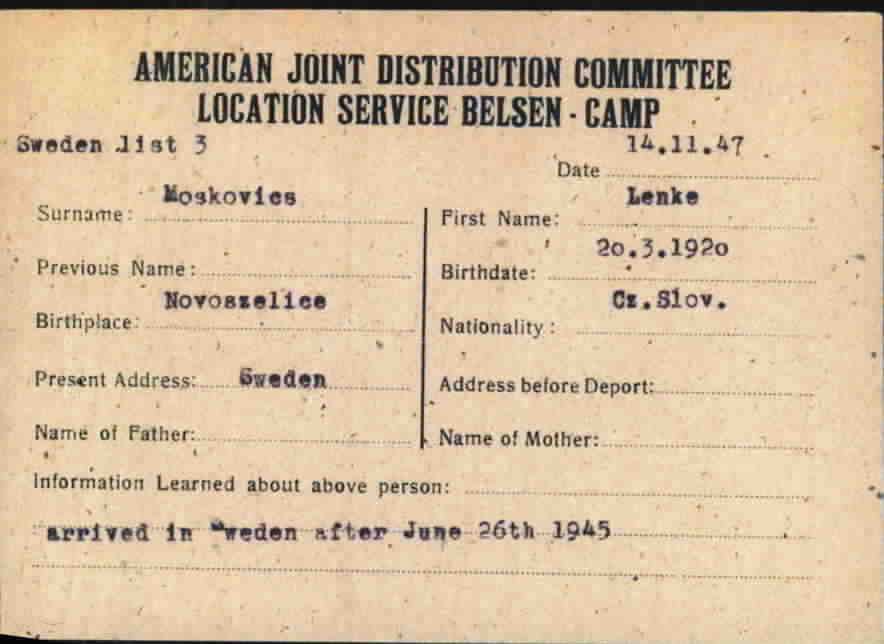
Index card from the American Joint Distribution Committee’s Location Service at the Belsen camp 1947
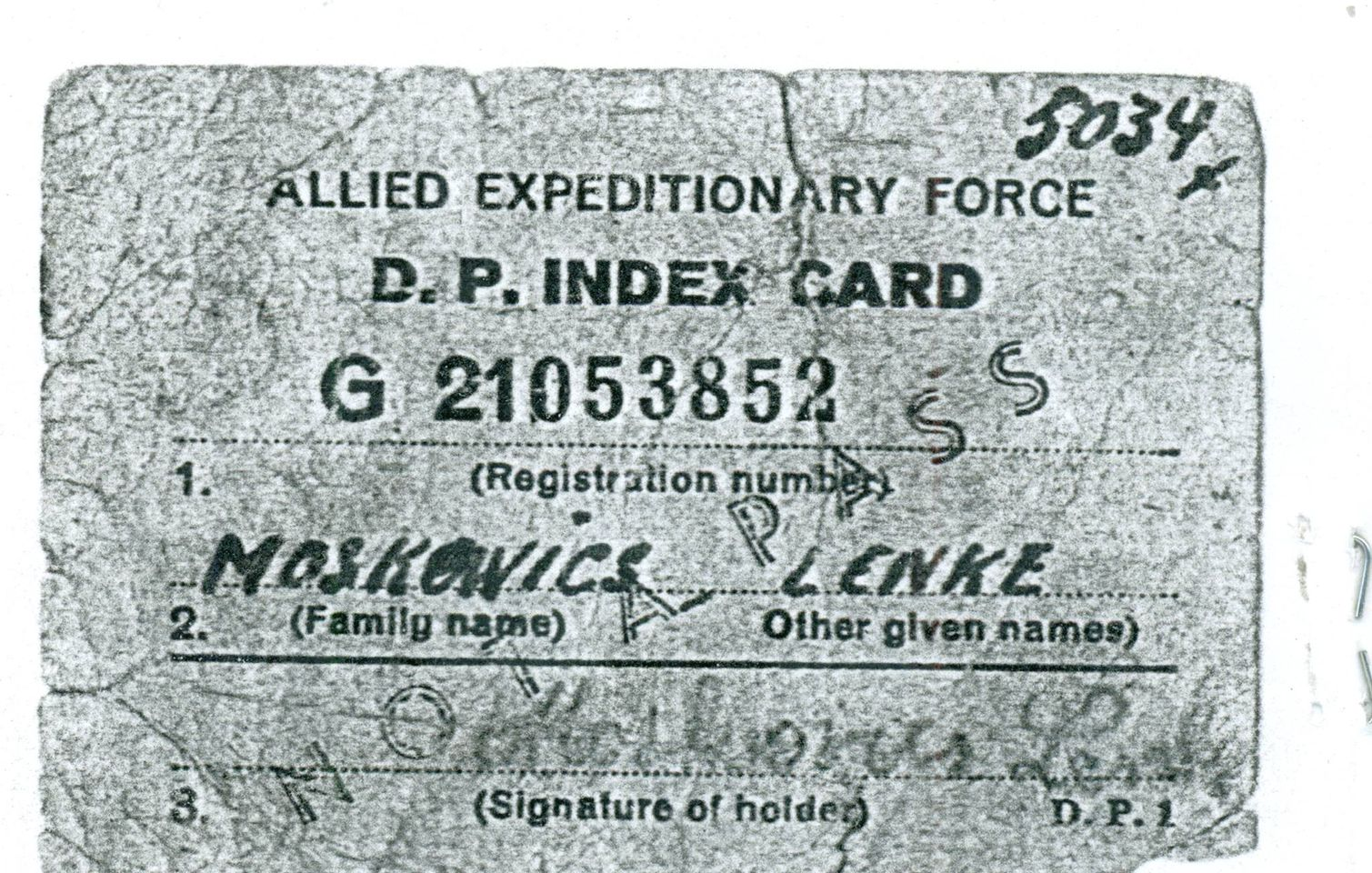
Allied Expeditionary Force DP Index Card - Displaced Person Card
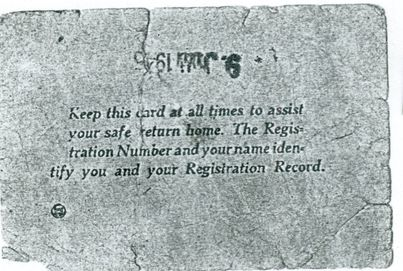
Back side of DP Index Card 1945
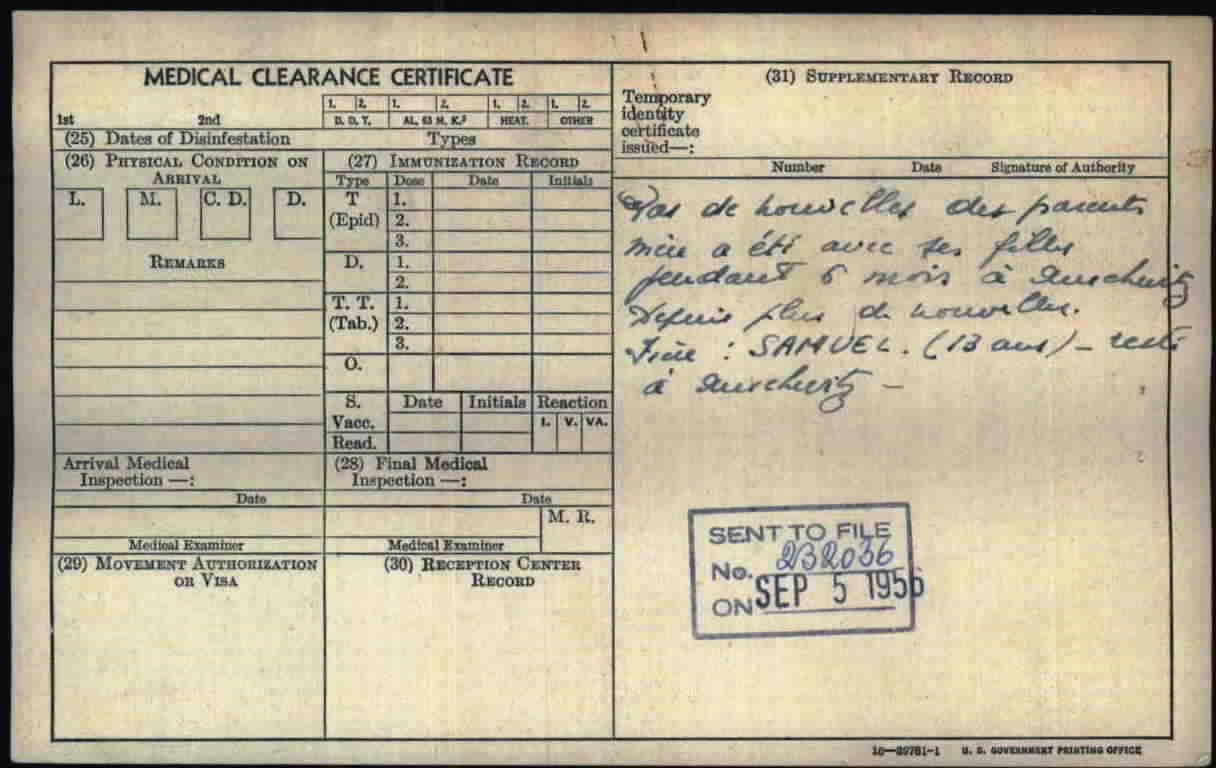
AEF DP Registration Record from the Arolsen Archives in Germany - Still shows married not knowing what happened to her first husband
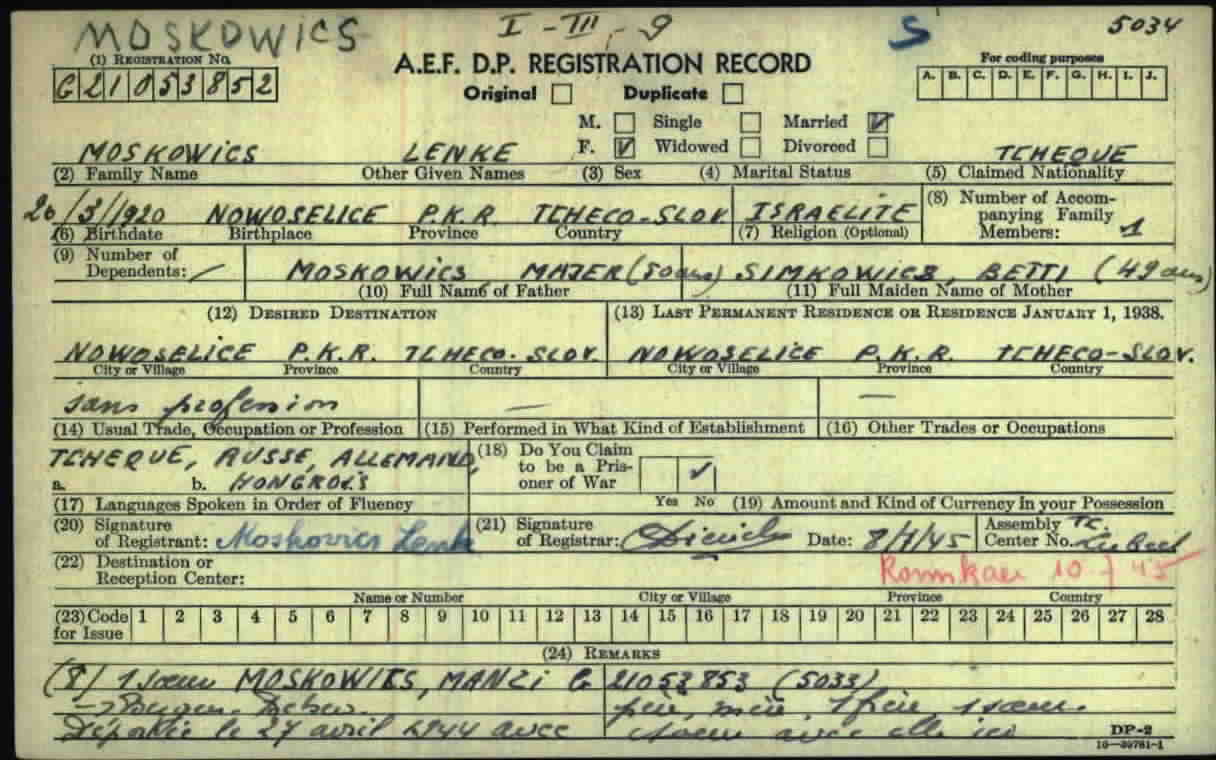
Reverse of the above registration in English: no news of the parents; the mother was with her daughters for six months at Auschwitz, and since then there has been no news; brother Samuel, 13 years old, stayed at Auschwitz