Lanka's Story·Part 7 of 8
Sweden, Marriage, and America
Chapter 7
Sweden, Marriage, and America
Lanka and Margaret arrived in Göteborg on July 21, 1945, and were placed in quarantine for three weeks.¹ The Swedes, who meant well, fed the survivors rich food, and the sisters, whose stomachs had not held anything heavier than soup for more than a year, took it slowly, first on toast and then on small portions of the fat-heavy diet that was served. Each morning the women stood in line to be given a spoonful of cod liver oil, and some of them refused it. Lanka told them that they had swallowed far worse than this and could swallow it. Margaret was hospitalized for her illness, and as she recovered she began to gain weight, and her hair grew back, and she became once again a pretty young woman. Lanka stayed in a reception camp for about three months. The food was kosher, and when Passover came in the spring of 1946 the Jewish community sent matzah, though the survivors largely organized their own observance. A man from Munkács came and invited them to keep the holiday at his house, but the girls preferred to stay where they were.
At the Czechoslovak consulate in Göteborg, where she was speaking with a Dr. Schultz, a woman walked in whom Lanka recognized at once. It was the Kapo from Chop who had struck her mother across the back with a stick in Birkenau, and the woman came toward her with her arms open, calling her by name and wanting to embrace her. Lanka told her to go away, and when the woman did not, she began to scream and to pull her hair. Dr. Schultz had to separate them, and Lanka told him who the woman was and what she had done to her mother. She said she had never forgotten it and that she had wanted to settle the matter.²
The Jewish community of Göteborg did little for the survivors, and what help they received came mainly from Gentile Swedes. The young women were often approached by Swedish men, and the survivors made a point of never going out with one man, only in groups. Lanka heard more anti-Semitism in Sweden, from people who had been spared the war, than she had heard at home in her childhood. Strangers on the street would say that a woman was Jewish because of her dark hair and crooked nose, and Swedes commented to one another that the Jews owned everything.
When the survivors were required to take work, Margaret found a job in a doll factory, and Lanka joined her there briefly but could not bear to sit still at such a repetitive task. A Swedish woman who employed several of the young women offered her a position in her household, and for a time she lived with a group of the survivors, slept in the living room, and took charge of the housekeeping. The family treated her well. As housing grew harder to find the young women were obliged to go their separate ways. Two of them left for America, and of the three who remained, one went to live with an elderly couple, Margaret went to live with the mother of a friend, and Lanka went to the household of an aristocratic family, which sent her to a short course to learn the formal Swedish style of table service, with its strict rules of rank and title.
On her first Yom Kippur in Sweden, she told the Christian woman she was living with that she would be fasting and would be away all day, and she walked a very long way to an Orthodox synagogue, having eaten nothing the night before. Afterward, as she walked home, she wondered whether one of the congregation, perhaps one of the rich Jews with their cars, would think to ask where a girl alone was going to break her fast, and no one did. She thought she would not make it home. When she arrived, the woman, Mrs. Carlson, who had known nothing about the fast, had baked a large ham and sliced it, and set it in front of her, and Lanka began to cry. She said that she could not eat it. She had cooked ham for the family and had never touched it herself. She asked instead for toast and cheese and coffee and scrambled eggs, and the woman made them for her, bewildered by her tears.
Margaret, by this time, had a suitor. He was a Swedish airman, very handsome, and she was a small blonde girl who learned Swedish almost at once. He took her to the movies, and Lanka, who thought that a walk alone across the fields at night was not safe for a girl of her sister’s age, went with another young woman to meet them on the way back. The airman did not like it, and he told Margaret that her sister should not come. Lanka told him that she was in charge of her sister, that he was not a Jew and that Margaret had no need of him, and she forbade her to go out with him alone. Margaret obeyed her, for the time being.
In 1947 a letter arrived from Martin Ilkow. He had been in the Soviet Union since the early years of the war and had learned nothing of what happened to the Jews of his home country. In 1947 the Soviet authorities allowed him to leave, though they urged him to stay, and he went home, thinking that his parents and the rest of his family would be waiting for him.³ He went to Uzhhorod and found people there, and they told him that there was no one left, that the whole of his family was gone. One of them recognized his name and said that Lanka, who had been his girlfriend before the war, had survived, and that he would find her in Sweden. He went on to Michalovce, where he visited Lanka’s cousins, and he hoped to marry the cousin who now lives in Ottawa, but she was already married. She gave him Lanka’s address, and he wrote to her. He told her that he was not married and that, if she had no one, it was fate that the two of them should marry. Lanka had not forgotten that her mother had urged her to choose the religious one of the two boys, and that it had turned out as her mother had said.
Around the same time, an American man who was visiting relatives in Sweden met Lanka, courted her for two weeks, and proposed. She refused him, but not before she had asked for his address in New York so that her uncle could inquire about his background. She accepted Martin’s proposal. Martin was brought to Sweden, and they were married in 1948. Their first daughter, Beverly, was born in Göteborg in 1949, in the eighth month of the pregnancy, so tiny that the doctors told Lanka that the typhus she had suffered at Bergen-Belsen had harmed the pregnancy. Lanka was determined to keep a kosher home, which in the late 1940s was not easy in Sweden, since kosher meat and other supplies were scarce. The couple observed the holidays as best they could, often with simple foods. Their Swedish neighbors were generally kind. One non-Jewish man, learning that they were about to emigrate and had almost no furniture, measured their windows and came back the next day with a truckload of household goods, telling them to take what they needed and pay him later. When they left, Lanka sold the apartment with the furniture and repaid him.
Margaret meanwhile had reached the age of twenty-one. She and Lanka had obtained visas for America, but Lanka, who had married and could not leave, was left behind, and she was determined that her sister at least should go, and so she sent her ahead to relatives. Margaret stayed in America a month or two. She sat and cried and held a photograph of the airman, would not eat, and finally went back to Sweden, because she was in love. Lanka had not accomplished what she had intended. Margaret stayed in Sweden for the rest of her life, and the sisters kept in contact. Lanka had promised her mother to take care of her sister, and she did, though she said, half laughing, that Margaret gave her a great many headaches and that it was worth every one.
Lanka had always wanted to reach America. Her grandfather’s dying instruction to leave Europe had never left her. Part of the delay was her own doing. She wrote from memory to the addresses of relatives, and some of her letters never arrived, while letters addressed to her in Sweden with nothing but her name and Göteborg found her at once. The relatives in the United States were slow to help, and one of them, her mother’s brother, did not want to help at all, and an aunt tried but not very hard. At last they sent affidavits. The Kesslers, her mother’s sister Frumet and her husband, were very good to them, sending a letter and five dollars each time they wrote and helping to bring them over, and Lanka repaid every dollar. The family left Sweden through the International Refugee Organization’s resettlement system as certified displaced persons, and not as ordinary quota immigrants.⁴ They sailed from Göteborg on the M/S Gripsholm on November 21, 1951, and the crossing took thirteen days, reaching New York on December 4.
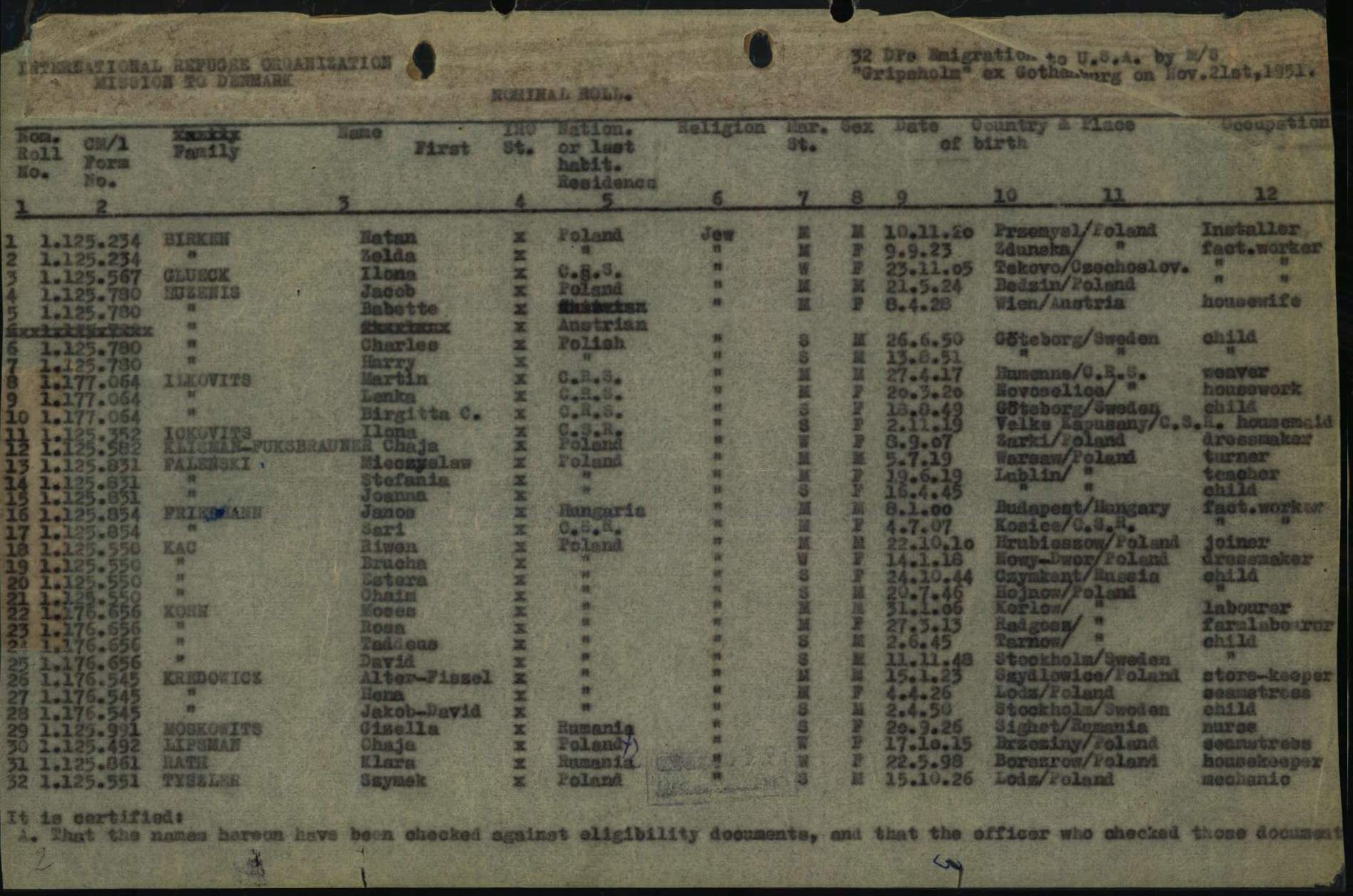
Their daughter had turned two that August. After the ship docked they spent a short time with relatives in New York, which was overwhelming after the camps and after Sweden. An aunt in Detroit, her father’s sister, paid for the train fare to Michigan, where the family connections and the industrial jobs offered a better chance of rebuilding.
America was a disappointment at first. Martin wanted to go back to Sweden, where Gentile neighbors had helped them, and Lanka, who had wanted America so long, felt it too. Her father’s sister Cilia, with whom they stayed, gave her photographs of her father as a young man of twenty-three and a letter he had written, and Lanka was so happy to have them that she sent copies to her mother’s sister Frumet, who had kept a picture of Lanka at seventeen, engaged. She wanted her children to know how she and her father had looked.
In Detroit the early years were hard. They lived first in an apartment on Hazelwood with her aunt, who called herself kosher but served milk dishes on the Shabbat meal, and who told Lanka, when she asked, that in America kosher meant clean. Lanka bought separate milk and meat dishes at the dime store and moved out with Martin as soon as they could. A cousin of the aunt found them an apartment, and someone lent them one hundred dollars under the table to take it. Martin, who had a traditional Jewish education and was widely read, worked for another cousin at ninety cents an hour and came home looking, she said, like he had been in a camp. Lanka stood outside talking to the neighbors, who told her what the factories paid, and she told Martin to look for factory work. The cousin gave him the day off to go, assuring him he would not find a job, but the factories were laying people off at that very moment and hiring others, and Martin was taken on, at first for a hundred or a hundred and fifty dollars a week with overtime. When he was laid off he peddled bread and eggs to Jewish households around Hanukkah, with the help of a man named Moshe Weiss, and they saved four thousand dollars, one penny at a time, as her mother had taught her.
They rented a house on Pasadena from a German man who, when Lanka told him what she had been through, said that what had happened in Germany had nothing to do with him and gave them a break on the rent. He later sold the house, and they had to find another. When she told her husband that they were getting nowhere and suggested that his wealthy cousins lend them a thousand dollars toward a house, they refused, and Lanka said that in America a person had to work for what she got. Lanka wanted to buy in Oak Park, but Martin’s salary did not qualify them for the mortgage on a house costing seventeen thousand dollars. They bought instead near Evergreen and Seven Mile in northwest Detroit, where there was a synagogue on the corner.⁵ Lanka, who had lived for years with no privacy of any kind, wanted a house of her own, and she said afterward that the need was connected to what she had lived through. She went to the synagogue and began working for the established caterers, where she learned the trade. One of the caterers, an Orthodox man, owed her a great deal of money, and when he did not pay her she took him to court and settled. After that she said she would never work for anyone else. She obtained the use of a synagogue kitchen on Seven Mile, where she had talked to the president, and Rabbi Schnipper had recently arrived. She was not busy at first, because she did a lot of house parties, but she gradually took over the kitchen. She built a catering business that lasted about twenty years, preparing meals for bar mitzvahs, weddings, and community events across Michigan. She became known for her reliability and for paying her suppliers promptly. The work was demanding, and she often prepared food at home and carried it to the hall herself. The suppliers trusted her. She always insisted on paying them in person and having time to look over what she had left over, and when a woman in the market was told that Lanka would come to pay, she gave her everything she asked for. She made kishke for the congregations, forty to a tray, and when she found that ten pounds of it were disappearing from the back of a delivery she stopped. When a neighbor reported her home kitchen to the health department, she asked the inspector whether he had permission to search her house, and afterward she packed the food into the trunk of a big car and drove it out so that no one could see. She catered all over Michigan, as far as Lansing, for about twenty years, until the synagogue was sold.
When she was pregnant with her second daughter she was so sick that she could not take care of Beverly, who was three, and the girl was born in the fall with no sockets in her hips. She had to have surgery at Children’s Hospital, and Lanka ran there between jobs. One day she got lost on the way, and a man who delivered linen to the caterers recognized her and said her credit was good.
She was determined that her children should be raised Jewish. When her older daughter was old enough, she sent her to a yeshiva, which made a deep impression on the girl and made her somewhat religious, but the tuition was more than the family could afford. Lanka asked Martin to tell the administrator that they could not pay, and he answered that if everyone asked not to pay there would be no one to pay the teachers, and he took her out. He placed her instead in the Workmen’s Circle, a secular Yiddish school that Lanka thought of as a communist place, and she was taught Yiddish there.⁶ Her younger daughter was sent to a Hebrew school and resisted going. She would come home and say that she had missed the bus, and Lanka, who had no second car, would answer that they were going to walk, and she walked her to the school herself. The girl was an excellent student who fought furiously over a single poor mark, and a teacher once told Lanka that she should consult a psychiatrist about it.
The psychological weight of what she had survived never left her. She suffered recurrent nightmares in which she was back on the selection ramp, or flying with her children in her arms and sliding down toward the gas chambers, and she would scream in her sleep. The first time her daughter Beverly ran to her bed asking what was wrong she told her something of it, and she began to talk about her experiences with her children only when they were teenagers, and later with school groups and interviewers. American people, when she first arrived, did not believe what she described, and she did not want to speak of it. She told her children to finish their food because she had once searched garbage heaps and found nothing. She could not easily look at the dead and avoided funerals whenever she could. When an old friend died whose family was not Jewish and no one was there to make a minyan, Lanka telephoned her friends and assembled the ten men herself, but when the dead woman’s daughter pressed her to come and see the body, she could not do it.
The sound of the German language, wartime films, or certain music brought strong reactions. Holidays were especially difficult because they brought back the songs her grandfather and father had sung at the table. In the camps she had often doubted that God existed. The birth of her daughter in Sweden began to restore a sense of faith and the obligation to raise the child Jewish. Still, she carried a lasting fear that hatred of Jews could rise again, even in America. She kept the memory of her grandfather’s warning and her mother’s final charge, which was to take care of her sister.
Footnotes
¹ Sweden accepted several thousand Jewish survivors for medical treatment and rehabilitation in 1945–1946. Many arrived through the Swedish Red Cross and were held in quarantine before being housed or sent to hospitals.
² After the war, Czechoslovak consulates reopened and served citizens abroad. In June 1945, Czechoslovakia ceded Subcarpathian Rus’ to the Soviet Union, and the region became the Transcarpathian oblast of the Ukrainian SSR, so that survivors from Lanka’s home found their native land inside the USSR.
³ After 1945 the Soviet authorities restricted movement across the new western border, and permission to leave required special approval. Many Jews from Subcarpathian Rus’ who had been in the Soviet Union during the war and returned in the first postwar years found that their families had been deported and killed. Martin’s journey is only sketched here, since Lanka did not describe his years in the USSR.
⁴ The International Refugee Organization (1947–1952) managed the resettlement of displaced persons, and the U.S. Displaced Persons Act of 1948, amended in 1950, allowed a larger number of survivors to enter outside the ordinary quota system. The M/S Gripsholm was a Swedish American Line passenger ship that sailed between Göteborg and New York.
⁵ In the 1950s and 1960s Detroit’s Jewish population moved steadily northwest from its older neighborhoods toward the area around Seven Mile Road and Evergreen, and then to Oak Park and, later, Southfield.
⁶ The Workmen’s Circle (Arbeter Ring) was a Jewish labor and cultural organization, founded in 1900, with a network of secular Yiddish schools. It was socialist in orientation.